
Permission to pause

We do not have to be doing all the time to be.
In fact, if we are doing all the time, we are not being.
—Madeleine L’Engle
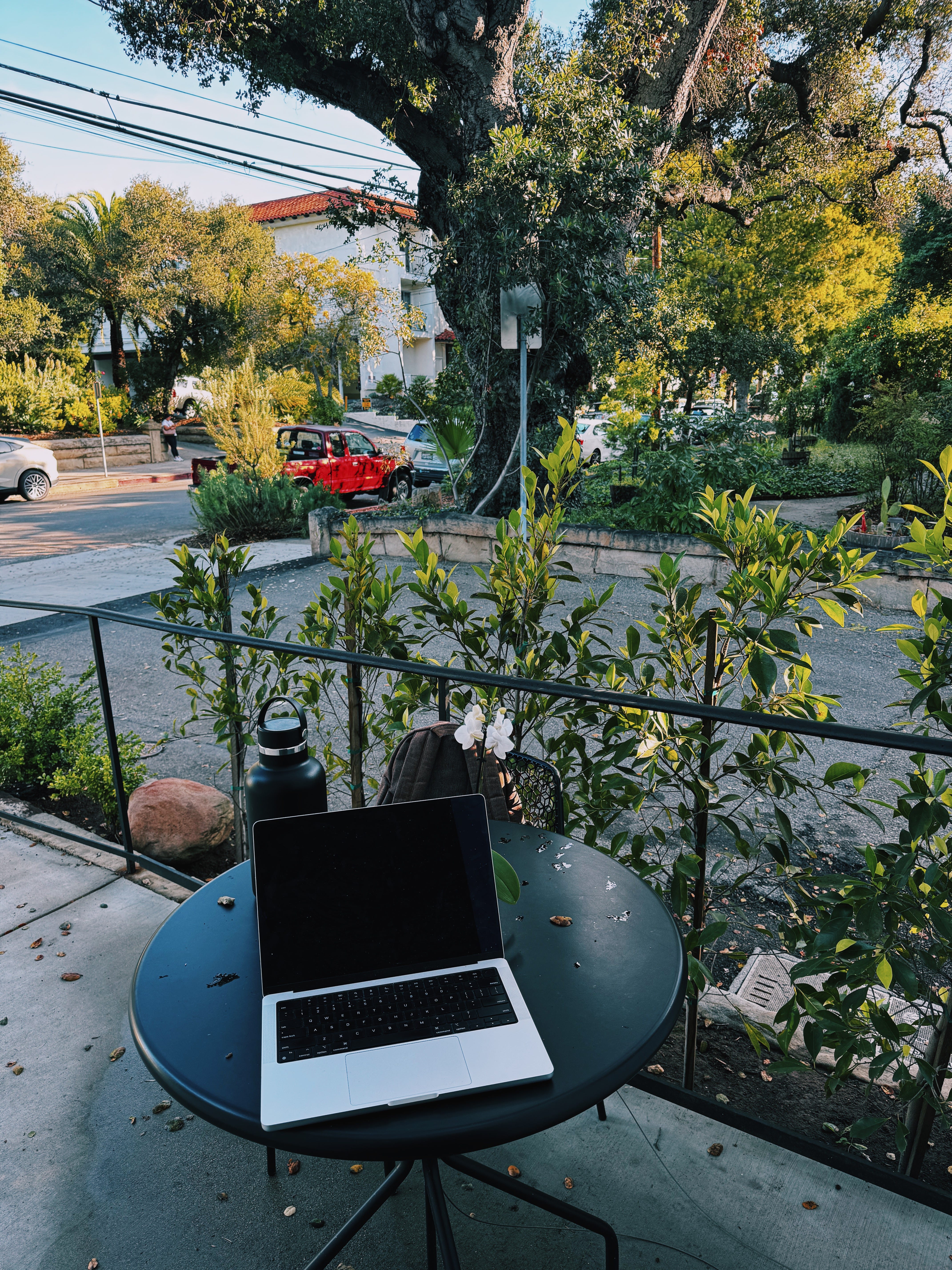
I’m sitting in a quaint courtyard at an Airbnb just off State Street in Santa Barbara, California. It’s 7am. Emily’s still sleeping (a rare gift for a mother of three young kids), so I grab my laptop, head outside, and try to write. My mind is freshest in the morning and life feels ripe with possibility.
But despite my charming surroundings, I’m stuck. It’s been over two months since my last newsletter—an intentional break to focus on my book, travel, family, and some health issues. I should have lots of ideas after taking time off, I think, but instead I’m caught in a creative cul-de-sac, cycling through topics that don’t excite me. There’s no spark. I’m getting nowhere.
This is when my thoughts get darker.
If I’m struggling this much to write a single newsletter issue, was I ever good at this to begin with? Does anyone care about this newsletter anymore? Why did I let it go dormant this long? Someone with more grit would have kept it going.
I’ve always struggled with discipline and consistency. When I started my newsletter two years ago, I was nervous about trying to publish something every week. I managed to write over 100 newsletters and produce 54 podcast episodes without missing a beat (besides a few planned breaks here and there). Kind readers sent me messages like “I don’t know how you produce so much content” and “I’m impressed by your healthy grind,” and it spurred me on.
Consistency is satisfying. It’s rewarding to push through resistance and do whatever it takes to ship something you’re proud of. When you go hard after a goal—whether it’s professional or personal—it feels good to be on a streak. This is what I call ‘positive momentum.’ It’s the compounding ROI of slowly building a body of work, which at first feels like pushing a huge boulder up a hill. However, the more you stay with it, the more momentum you build, until the boulder starts rolling faster with the same amount of effort.
Positive momentum is a wonderful feeling. But lately, I’ve experienced the opposite.
Breaking the streak
Sitting there in Santa Barbara, the momentum I’d worked so hard to build seemed to disappear. Even though I planned my newsletter hiatus to free up creative bandwidth for my book, I still felt guilty about it. Suddenly, everywhere I looked I saw someone being more consistent, producing more content, receiving more engagement. I was oozing along like molasses in a world of meteors, wondering if it was worth it to keep going.
Have you ever felt this?
Eventually, we all break the streak. Life happens, you lose steam, get distracted, get sick, or just need a break. We dig ourselves into a mental hole that feels impossible to climb out of. If you let it, negative momentum will bully you into self-doubt. What’s helped me hasn’t been positive self-talk or doubling my efforts to try to make up for lost time.
What’s helped me most is simply giving myself permission to pause.
The freeze
Even Duolingo, one of the most successful apps to use the streak feature, acknowledges our need for breaks. They have a feature called the “streak freeze” which allows you to hit pause on learning for a day. The company says,
Having this type of leeway actually helps people stay persistent. Offering people a little “slack” as they pursue their goals can be more motivating than a rigid set of rules.
Rightfully so, we obsess over consistency. It’s the “key to creativity” as they say. And I agree. But while consistency makes creativity possible, flexibility makes creativity sustainable. A stick that’s too rigid will snap. So it is with our lives, our creative work, everything.
Recently I was part of a discussion about an author’s upcoming sabbatical. His plan was to pause all professional pursuits. Specifically, we were discussing whether he should let his weekly newsletter go dormant for several months or schedule “replays” of his previous issues to avoid losing audience engagement. This author works hard, is a content machine, gets a few hours of sleep each night, and does it all with contagious joy and puzzling energy.
Unexpectedly, someone asked me, “Will, what do you think?” All eyes were on me.
I felt torn, caught between the strategic answer (keep publishing) and my gut answer (let it rest). I said something like, “A world where it’s not possible to take breaks scares me.”
And it does, even though I’m often the very person beating myself up whenever my consistency wanes. I wanted to give the author permission to pause. I want that for myself. I want that for you.
If you’re driven and passionate, chances are you need someone to give you permission to pause. So if you’ll accept it, this is your permission slip. Every once in a while, cut yourself a little slack. Let the boulder sit there for a while.
If God has lit a fire in you to make this thing, to do this thing, to pursue this thing… giving yourself permission to pause will not derail your calling. And even when it happens unexpectedly and it feels like failure, it’s normal. If you’re so in love with this thing, so caught up in wonder about its possibilities and the joy it brings you and others, don’t assume that flexibility is the enemy of consistency. Let them mingle, then watch how you return to the work renewed and determined.
I’m rooting for you.
Will
Do you schedule regular breaks from your creative work, or is this something you struggle with? I’d love to hear from you.
If you enjoyed this, would you share it with someone who would benefit?

Hey, I’m Will Parker Anderson, a Senior Editor at Penguin Random House Christian. A lot of writers feel trapped on the outside, like writing and publishing are an elite inner circle they’re not welcome to join, and they feel alone & intimidated.
I want to change that, so I created Writers Circle—where I make insider knowledge open to everyone, so writers like you feel seen, equipped, and encouraged as you steward the words God has given you. My goal is to make writing less lonely and your next step more clear.
So many writers I'm currently coaching are exhausted. Yesterday alone, I encouraged three separate writers to press pause. Even nature teaches us this: We sow, we wait, we harvest, we rest.
My first career was a musician, and taking a break always felt like going backwards. Especially surrounded by others practising hours and hours a day.
Now, as a meditation teacher, I see the most successful practice comes when we give ourselves a little break. Same was true writing a PhD,.
I do think the down tine should still be meaningful. It seems justvwasting time doesn't recharge us the way doing something meaningful to us does.