
The passion pay gap

On my most ambitious mornings, my alarm goes off at 5:23am (I always set my alarms to numbers ending in 3—I know, it’s weird), and I drag myself out of bed, eager to put in some writing time before the kids wake up. But inevitably, just as I manage to shake off the sleepiness enough to get some words on the page, the pitter patter of little feet alerts me that it’s time to officially start the day. Time slips away before I can make the progress I want to.
The sunrise, meant to be a thing of beauty, becomes a burning reminder that I will never have the time I want to pursue writing. Though I’m grateful for the life I have, I long to gallop headlong into my passions, but most days, I creep forward like an inchworm.
Add to this frustration the fact that, seemingly everyone else—influencers, musicians, entrepreneurs, authors—seem to spend their days doing what they love and getting paid handsomely to do so. If only my job was my passion, I theorize, then I’d be fulfilled.
What about you… Do you ever lament the fact that you don’t have enough time to pursue your passions?
If yes, let me assure you: you’re not alone. The fact that you’re not pursuing your passion full-time doesn’t mean you’re untalented. Or boring. Or unimaginative. Or lazy. And it certainly doesn’t mean you should give up.
Surprisingly, the solution to our frustration isn’t finagling our schedules for more time; it’s reframing how we think about passion and calling.
Perhaps an overused Venn digram will help clear things up…
A terrible definition of calling
Maybe you’ve seen this Venn diagram, which depicts “calling” as a combination of “things I like to do”, “things I’m good at”, and “things that make money.
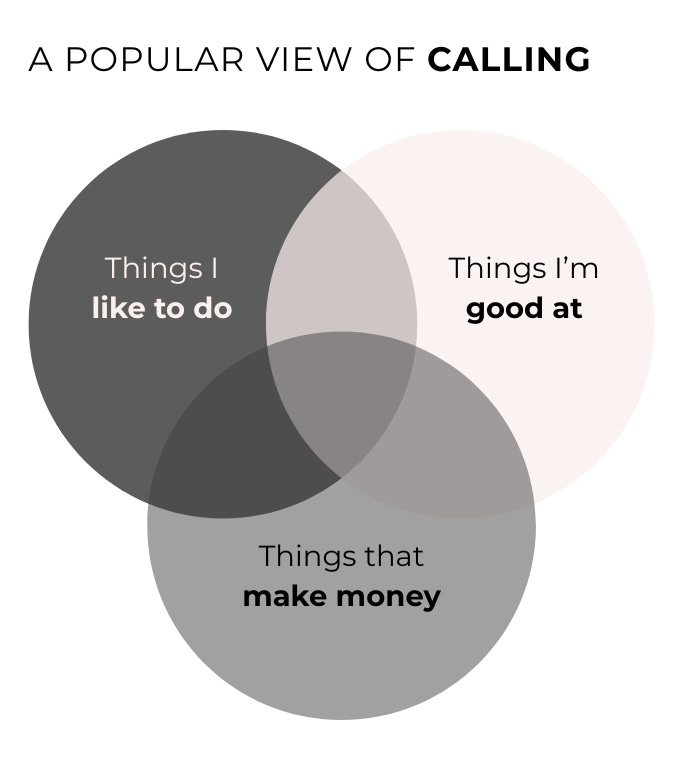
The goal, it’s argued, is to find the perfect overlap of all three, but the problem should already be obvious: few of us get paid to do only what we love. Instead, our jobs and families take the bulk of our time.
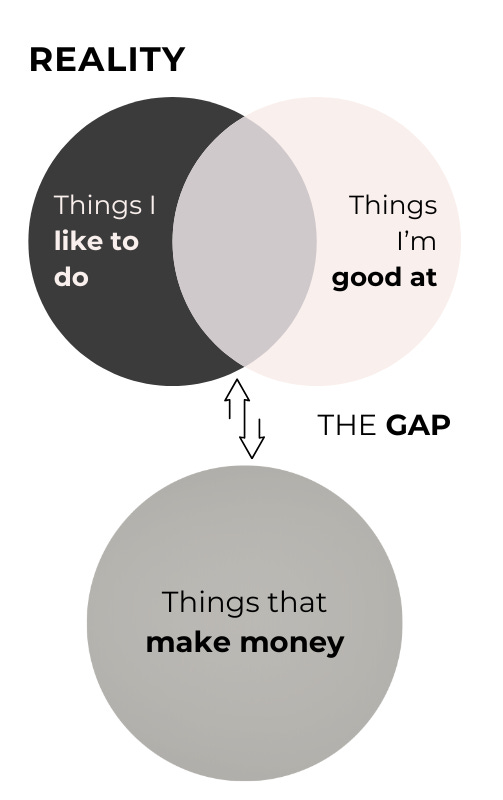
This perplexing disparity between what we have to do to earn a living and what we want to do is what I call “the passion pay gap”.
If we revise the Venn diagram to reflect real life, it looks like this:
So, what now?
At first, realizing your passions may not produce a paycheck is deflating. But it doesn’t have to be. If, like me, your passions are squeezed into the minuscule margins of a very full existence, here’s a few encouragements to keep your spirit buoyant …
1. Even if your job isn’t your passion, it makes your passion possible.
The problem with expecting to be paid for our passions is that when it doesn’t happen we grow resentful toward the job(s) God has provided. It stings to realize that we may never professionalize our passions.
You may not enjoy your day job (thankfully, I do), but even so it funds your passion in one way or another. In my case, I’ve funded my own podcast for the past two years. Without my editorial role at Penguin, Writers Circle wouldn’t exist.
From another angle, even the fact that we have time to think about our passions reveals how fortunate we are. Had you asked the ancient blacksmith or peasant what his or her passion was, you would have been met with a vacant stare. In many places in the world today, harsh economic and political realities make survival—not passion—the primary concern. Every minute we spend pursuing a passion is a gift.
What about you? In what ways does your unglamorous, dutiful full-time work make your passion possible?
2. Pursuing your passion full-time could kill your love for it.
Getting paid to do only what you love sounds dreamy, and it might be. I say might because pursuing your passion full-time could, paradoxically, drain your love for that thing. When passion becomes work, sometimes joy is swallowed up by obligation.
One full-time author confessed to me, “I miss the days of waking up at 4am to work on my book before starting my full-time job. It was tough, squeezing writing into the margins, but it motivated me to work hard on something I believed in.” Ironically, now that he writes full-time, motivation is harder to muster since he technically can write whenever he wants to.
What if scarcity—not having as much time as you want to pursue your passion—creates the necessary urgency to do your best work? For some writers (or fill in the blank with your passion), having eight uninterrupted hours a day to pursue your passion would eventually feel more like purgatory than paradise.
3. Just because you don’t get paid doesn’t mean it’s pointless.
It’s easy to feel like a loser in a world teeming with twenty-something influencers who make multiple six figures (or more), or solopreneurs who have monetized their skills lucratively (and want to sell you their course so you too can stick it to the man and pave your own path). Or perhaps you simply know folks fortunate enough to do the thing you dream of doing full-time.
There’s a myth that says if you don’t get paid to do what you love to do, you should stop doing it. Says who? The word amateur literally means “lover.” If something’s in your blood—if you love it—who cares whether or not it grows your bank account?
Os Guinness writes,
“There are many things we do, not for profit, but for the sheer love of doing them. Whether we are doing it for our own sake or the sake of others, we are happy to be doing it, even if nobody is watching us and nobody pays us.”
Live in the gap
Here’s an uncomfortable but liberating question: What if, despite your deepest hopes and focused efforts, the three circles of your Venn diagram never fully overlap… but even so, you still enjoy what you love and use your gifts to make things that are good, true, and beautiful?
My friend, if you never make a living from your passions, you can still make a life. Even the scraps of time, so tattered and thin, can be woven into a tapestry that brings warmth to you and those you share it with.
Don’t lay down your joy to sing a dirge to the paycheck that refuses to come. Do what you were created to do, and if and when someone offers to pay you, let it be a pleasant surprise.
Here’s to living in the gap.
I’m rooting for you,
—Will
What did this post stir up in you? I’d love to hear your thoughts:
If you enjoyed this, would you share it with someone who would benefit?

🎧 This week on the Writers Circle podcast, I interview songwriter and author Andrew Peterson about learning to be misunderstood in order to create honest art. You can listen here: Apple or Spotify.
👉 Become a paid subscriber today and get access to ‘Writing with Will”, a behind-the-scenes podcast where I document in real-time the process of writing and publishing my first book. You can sample the first episode here.
Hey, I’m Will Parker Anderson, a Senior Editor at Penguin Random House Christian. A lot of writers feel trapped on the outside, like writing and publishing are an elite inner circle they’re not welcome to join, and they feel alone & intimidated.
I want to change that, so I created Writers Circle—where I make insider knowledge open to everyone, so writers like you feel seen, equipped, and encouraged as you steward the words God has given you. My goal through this newsletter (and my podcast) is to make writing less lonely and your next step more clear.
My opinion on this topic has changed radically in the last couple of years. I also used to believe in that pie in the sky idea of having a vocation that ticked all the boxes, but I’m quite opposed to the whole idea now. Now I feel that what I do for money should be something that I have strong drive and conviction to do. I am a farmer, I wouldn’t say I’m a good farmer. I earn less than what I could elsewhere, but there’s something about the generational aspect to it that gives me immense drive and conviction to do it. I have lots interests, side hustles and hobbies - lots of fingers in lots of pies. The thing is I think all of those pies make my life dynamic and feed my creativity. Go heap up a whole lot of financial pressure on one of those things I love to do and I don’t think I will love to do it anymore. The big thing is just balance, if you start saying no too much to family time, serving in church, then you are in trouble. Unfortunately when I am burning the candle at both ends i can quickly tell because then I have no words to write - it’s a bit of a canary in the coal mine.
In 2019, I was about ready to give up writing novels, and royalties (or lack thereof) was one of the biggest reasons. However, the thought of giving it up made me so depressed. I finally changed my attitude by reminding myself that other people spend time and money on hobbies like knitting or restoring old cars--why couldn't I enjoy my writing that way? It made all the difference--since then, I've written and published over 50 books and short stories.